Welcome to Ukcoinsvalue, your expert source for valuing rare Great Britain coins online. On this page, you can explore all UK coins issued by the Royal Mint. They are organized by denomination, making it easy to find British coinage values that interest you. This is a complete and regularly updated list.
To make sure you don’t miss any information about new British coin releases, and to receive exclusive content such as our list of rare UK coins, don’t forget to subscribe to our newsletter below.
What are rare English coins?
The answer depends on each collector. For many people, a coin feels special simply because they are seeing it for the first time. This is often the case when searching for rare UK coins, where unfamiliar designs or pieces rarely encountered in circulation can give the impression that they are uncommon. Others take a more objective approach and look at mintage figures: the fewer coins produced, the harder they are to find. This is typically how collectors identify rare sterling coins, based on actual numbers rather than personal perception.
Finally, some collectors focus mainly on specific denominations such as 50p and £2, as these are commonly used for commemorative releases. In that context, a British rare coin is often linked to special editions or limited issues, while rare English pound coins can also attract attention due to design changes or short production runs. If you’re interested in the topic, you can visit our UK coins books page to learn more, or simply click on one of the sections below to discover our guides and view them directly on Amazon.
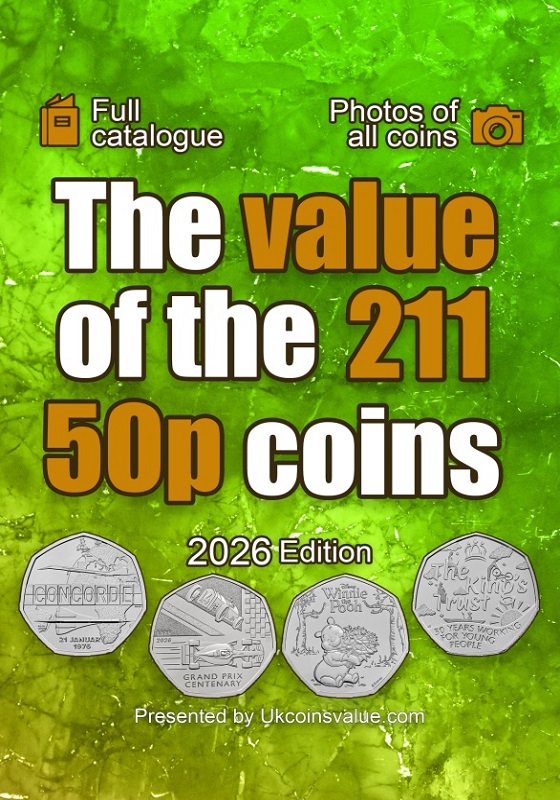 | Image of each 50p ever minted Meaning of all 50 pence coins Stories about some mintages Value for each numismatic grade |
British pieces classified by denomination
Below, you can select the denomination you are interested in. Many rare UK coins come from the 50p and £2 denominations, but it is also interesting to explore the six other denominations. As you will quickly realize, many British coins are fascinating not only in terms of their value, but also for their history and meaning.
Methodology to determine the value of a UK coin
To estimate the value of a British coin, the first step is to analyze recent sales observed on the market. Completed listings on auction platforms, dealer transactions, and collector exchanges provide the most reliable indicators. By focusing on actual selling prices rather than listed offers, it becomes possible to identify a realistic price range and avoid inflated expectations. This approach ensures that the valuation reflects current demand and not speculative pricing.
When a piece is only available within a collector set, the method differs slightly. In that case, the current market price of the set must be considered, then distributed proportionally between its elements. For example, if a set is worth £4.88 and includes a 50p piece, assigning roughly 10% of the total value to that element is a logical approach. This proportional method helps determine the value of an English coin even when it is not sold individually.
By combining real transaction data with proportional valuation for collector sets, it becomes possible to establish a consistent and realistic pricing framework. This methodology avoids overestimation and provides collectors with a clear, market-based reference.
The Different Numismatic Grades
In numismatics, the condition of a coin plays a crucial role in determining its value. Collectors and investors rely on grading standards to assess how well it has been preserved over time. Among all existing grades, three stand out as the most important: UNC, BU, and PR.
- UNC (Uncirculated) refers to a piece that has never been used in everyday transactions. It shows no signs of wear from circulation, although it may still have minor marks from the minting process or handling. These pieces retain their original mint luster and sharp details, as seen on a typical British coin in mint state.
- BU (Brilliant Uncirculated) is a higher-quality subset of uncirculated pieces. A BU example not only has no wear but also displays a stronger visual appeal, with a brighter shine and fewer imperfections than standard UNC quality. These are generally sold in protective blister packs, often accompanied by printed cards, visuals, and explanatory text, which is common for a modern UK coin intended for collectors.
- PR (Proof) pieces are struck using a special minting process. They are not intended for circulation but for collectors. Proof issues are typically presented in a protective capsule, often placed inside a high-quality box (frequently made of wood), sometimes with a certificate of authenticity. They are easily recognizable thanks to their mirror-like background, which shines much more than other finishes, combined with frosted design elements that create a strong contrast, like a high-end English coin.
In most cases, these three categories (UNC, BU, and PR) are the only ones that can significantly increase value. Lower grades, especially pieces that have been in circulation, usually have little to no premium. As a general rule, a piece found in everyday change will typically be worth only between one-third and one-half of the value of an UNC example (or BU / PR if no UNC version exists), except in rare and specific cases.
| Image of each 50p ever minted Meaning of all 50 pence coins Stories about some mintages Value for each numismatic grade |
Why do we talk about valuable British coins when others have little value?
This difference is mainly driven by market demand. When there are enough pieces in circulation, the Royal Mint stops producing them. However, if there is a shortage, new ones are struck to meet demand. This constant adjustment explains why some mintages become extremely common over time, while others remain much harder to find.
As a result, certain years were produced in very large quantities, making those coins widely available and of little interest to collectors. In contrast, coins with low mintage figures are far less common and tend to attract more attention, as collectors often classify them as rare British pound coins. This is exactly why some pieces are listed among valuable UK coins, as scarcity combined with demand naturally increases their market value.
How often does the Royal Mint release new UK coins?
It depends on the type of coins being considered. For the ones intended for circulation, production is based on demand. When existing stocks are no longer sufficient, the Royal Mint restarts minting to produce enough pieces to meet the needs of the economy. This is why some English coins are produced in large quantities at certain times, while others may not be struck again for years.
Alongside circulation coins, there is also a strong collector market. This is where new British coins are regularly released in higher-quality finishes such as Brilliant Uncirculated (BU) and Proof. Each year, collectors can typically find the 8 definitive coins (from 1p to £2) issued in BU and/or Proof, along with around 5 to 10 commemorative 50p and 3 to 6 commemorative £2.